Research

The main goal of the research programme is to foster innovation in the field of experimental and clinical medical physics to improve the detection, characterization and treatment of cancer, thus opening new avenues in the field of image-guided cancer therapy. GRK2274's main focus is on advancing imaging and therapy with non-ionizing and ionizing radiation, from more fundamental pre-clinical developments up to clinical translation and evaluation, in close connection with experienced clinicians. In addition to the Ph.D. projects, the research programme comprises clinical projects for M.D. candidates. The twofold goal is to ensure the clinical relevance of the research projects as well as to establish a platform where physicists and other researchers can communicate with clinical partners to acquire an understanding of the specific principles and challenges of the different disciplines.

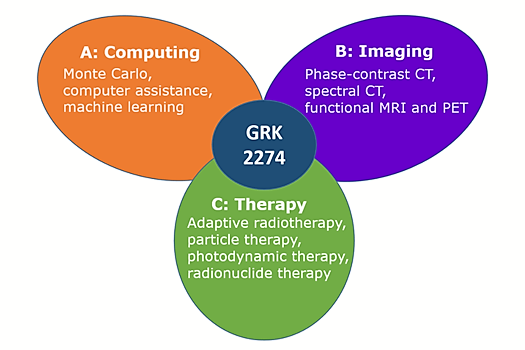
The research programme is structured in three core areas:

Research Area A - Computing
Computing is a research area where technologies that can benefit several applications are explored and developed, with emphasis on advanced modelling of radiation transport by Monte Carlo methods (MC) and image processing by machine learning algorithms.

Research Area B - Imaging
This area comprises research in imaging using multiple modalities, e.g. phase-contrast X-ray imaging, single photon counting for spectral CT, dual energy computed tomography (DECT), hybrid PET/MRI systems and advanced MRI sequences for functional imaging, fingerprinting and radiomics.

Research Area C - Therapy
Research area C will address fundamentally new developments in pre-clinical external radiotherapy (RT) based on laser-accelerated protons, as well as advance treatment techniques already in clinical use, namely external radiotherapy with photons and neutrons, internal radionuclide therapy and photodynamic therapy.